

August 19, 2026 • Katharine Liberatore
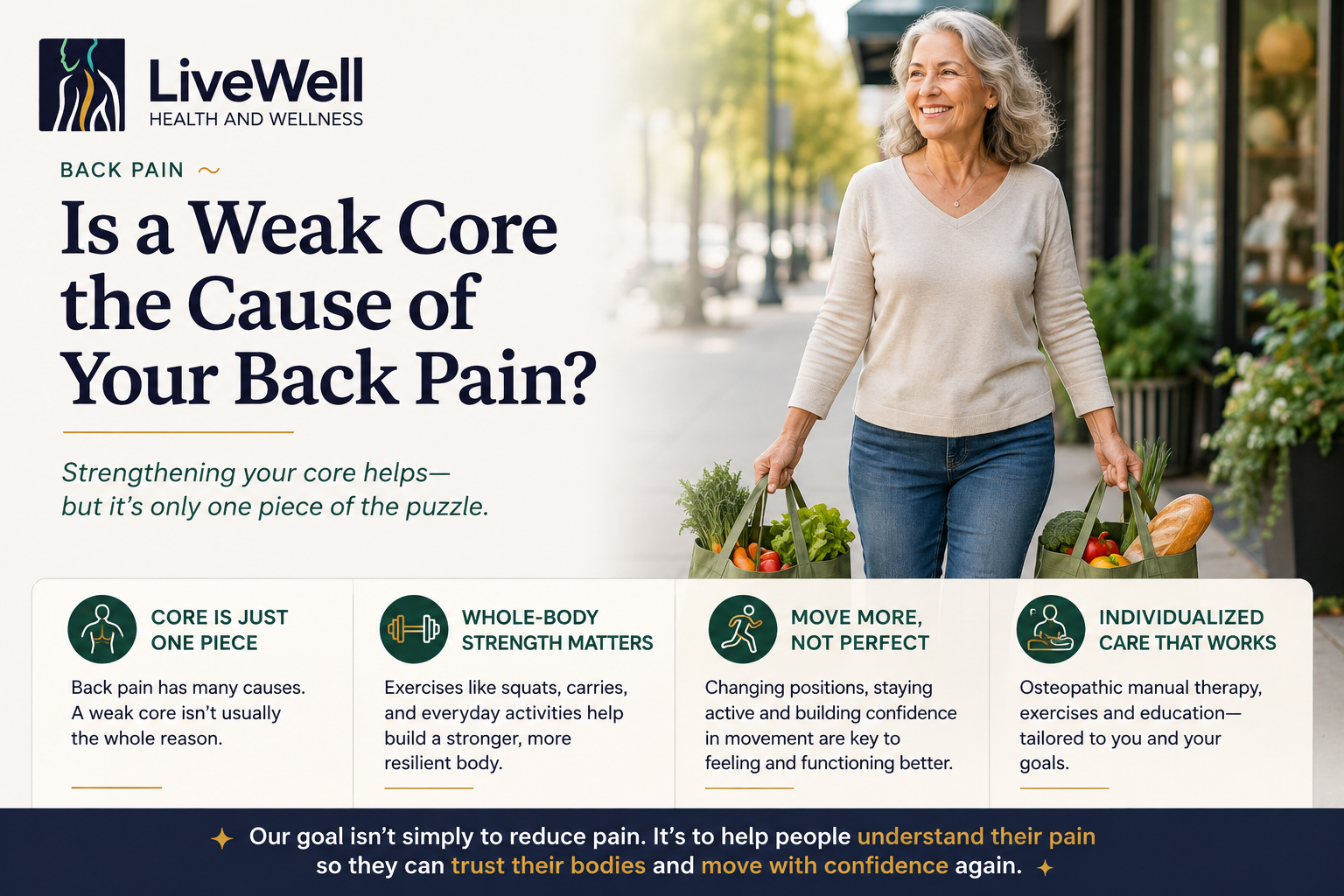
Is a Weak Core the Cause of Your Back Pain?
Discover if your weak core is truly the cause of your back pain. This article explores the complex relationship and provides a more holistic view of back health.
Understanding why strengthening your core can help—but isn't the whole answer.
If you've ever had back pain, chances are someone has told you:
"Your core is weak."
Maybe you've been told to do planks.
Maybe you've been shown exercises to "activate your core."
Or perhaps you've been told your back hurts simply because your core isn't strong enough.
It's one of the most common beliefs about back pain.
But is it true?
The answer is...
It's more complicated than that.
════════════════════════════════════
What Is Your Core?
When most people think of the core, they picture their abdominal muscles.
In reality, your core includes many muscles that work together to support and move your spine, including:
Your abdominal muscles Your back muscles Your diaphragm Your pelvic floor Muscles around your hips
These muscles work together every time you walk, bend, lift, reach, or simply stand upright.
They're important—but they're only one part of a much bigger picture.
════════════════════════════════════
Does a Weak Core Cause Back Pain?
Not necessarily.
Here's something I often tell patients:
Strong people get back pain. Weak people get back pain. The difference isn't simply how strong your core is.
Both research and clinical experience tell us that people with strong cores can still develop back pain, while some people with relatively weak cores never do.
If core weakness were the only cause, we'd expect everyone with a weak core to have back pain—and that's simply not what we see.
Back pain is influenced by many factors, including:
Previous injuries Sleep Stress Overall physical activity General strength and conditioning Individual sensitivity of the nervous system
That doesn't mean strength isn't important. Like any other part of the body, muscles that aren't accustomed to a sudden increase in demand may become sore or overloaded. Strength and conditioning absolutely matter—they're just rarely the only explanation for back pain.
Your core is one piece of the puzzle—but it's rarely the entire puzzle.
════════════════════════════════════
So, Are Core Exercises Worth Doing?
Absolutely.
A stronger core can improve strength, endurance, stability, and confidence in movement.
But the mistake is believing that core exercises are the only exercises you need.
Research suggests that regular exercise—including whole-body strengthening—can reduce pain and improve function in many people with persistent back pain.
That's why a well-rounded exercise program often includes much more than planks and abdominal exercises.
Walking.
Squats.
Deadlifts.
Loaded carries.
Gardening.
Playing with your children or grandchildren.
Many everyday activities naturally challenge and strengthen your core without you even thinking about it.
════════════════════════════════════
Is There One Best Core Exercise?
No.
One person may benefit from planks.
Another from dead bugs.
Another from loaded carries.
Another may simply need to become more active.
The best exercise depends on your symptoms, your goals, your fitness level, and what you enjoy enough to keep doing consistently.
The best exercise for one person with back pain may be completely different from the best exercise for someone else.
════════════════════════════════════
What About "Core Activation"?
You may have heard that you need to consciously tighten your core before every movement.
For some people, learning how to engage their trunk muscles can be helpful early in rehabilitation.
But for most everyday activities, your brain already coordinates these muscles automatically.
You don't consciously activate your core before you sneeze.
Or laugh.
Or climb stairs.
Or catch yourself if you trip.
Your nervous system is remarkably good at organizing movement without you having to think about every muscle.
════════════════════════════════════
How We Can Help
At LiveWell Health and Wellness, we know that no two people experience back pain in exactly the same way.
That's why we don't believe in one-size-fits-all treatment plans.
Following a thorough assessment, we'll work with you to develop an individualized treatment, movement, and exercise plan based on your symptoms, your goals, and the best available evidence.
Your treatment will include osteopathic manual therapy, along with individualized exercises, education, and practical strategies designed to help you move more comfortably and confidently. Osteopathic manual therapy uses gentle hands-on techniques to help improve mobility, reduce pain, and support your body's natural movement.
For some people, the focus may be on improving mobility. For others, it may be building strength, restoring confidence in movement, or gradually returning to work, sport, or the activities they enjoy.
Our goal isn't simply to reduce pain. It's to help people understand their pain so they can trust their bodies and move with confidence again.
════════════════════════════════════
The Bottom Line
Core strength absolutely matters.
But it's only one piece of the puzzle.
Building a stronger body, staying active, and following an individualized treatment, movement, and exercise plan are often far more important than focusing on one muscle group alone.
Strengthening your core is only part of the picture. Learning to trust your back again—and becoming less fearful of movement—is just as important. We'll dive deeper into why your back was designed to move, and why fear of movement can sometimes slow recovery, in an upcoming article.
════════════════════════════════════
Disclaimer
This article is intended for general educational purposes only and should not replace individualized medical advice. If you're unsure which exercises are appropriate for you, consult a qualified healthcare professional for an individualized assessment.
Book a visit
Book with Katharine Liberatore
Continue the conversation in clinic. Same-week appointments are usually available.
Book with Katharine