

August 19, 2026 • Katharine Liberatore
Why Do I Feel So Stiff Even Though I Stretch?
If you stretch regularly but still feel stiff, it might not be due to a lack of flexibility. Discover why the feeling of stiffness is often more complex than simple muscle tightness.
Why Do I Feel So Stiff Even Though I Stretch? If you're constantly stretching but still feel tight, the answer may not be that you need more stretching.
You stretch your hamstrings every morning.
You stretch your hips after exercise.
You roll your back, stretch your neck and maybe even spend 20 minutes doing mobility work.
And yet somehow you still feel stiff.
It's easy to assume this means your muscles simply aren't flexible enough.
But the sensation of stiffness is more complicated than that.
════════════════════════════════════
Feeling Stiff Doesn't Necessarily Mean You Are Stiff
This is probably the most important point.
Feeling stiff and actually having limited mobility aren't necessarily the same thing.
Some people feel extremely stiff but have perfectly good range of motion. Others have measurable restrictions in mobility but don't particularly feel stiff.
That's because stiffness is a sensation, not simply a measurement of how short or tight your muscles are.
Your nervous system, recent activity, how long you've been sitting, exercise load, sleep and stress can all influence how stiff you feel.
Here's an interesting example: under anesthesia, when muscle activity and protective guarding are reduced, clinicians can sometimes observe considerably more passive range of motion. The bones haven't changed and the muscles haven't suddenly become longer. It illustrates how much influence the nervous system can sometimes have over the movement your body allows.
Of course, some restrictions are structural—things like joint anatomy, arthritis or scar tissue can genuinely limit movement. But not every feeling of stiffness means something is physically shortened or "stuck."
So when someone tells me, "My hamstrings are always tight," one of my first questions is:
Are they actually restricted—or do they just feel tight?
Those aren't always the same thing.
════════════════════════════════════
So Why Does Stretching Feel So Good?
Because stretching can absolutely change how you feel.
After stretching, you may have more range of motion and feel looser and more comfortable.
But that doesn't necessarily mean you've physically "lengthened" a muscle that had become too short.
Part of what can change is your tolerance to the sensation of stretch. Your nervous system becomes more comfortable allowing you into that range.
With consistent stretching over time, physical adaptations can occur as well.
And this explains something many people have experienced:
You stretch. You feel fantastic. Then a few hours later, you're tight again.
That doesn't mean stretching failed.
It may simply mean stretching isn't the whole answer.
════════════════════════════════════
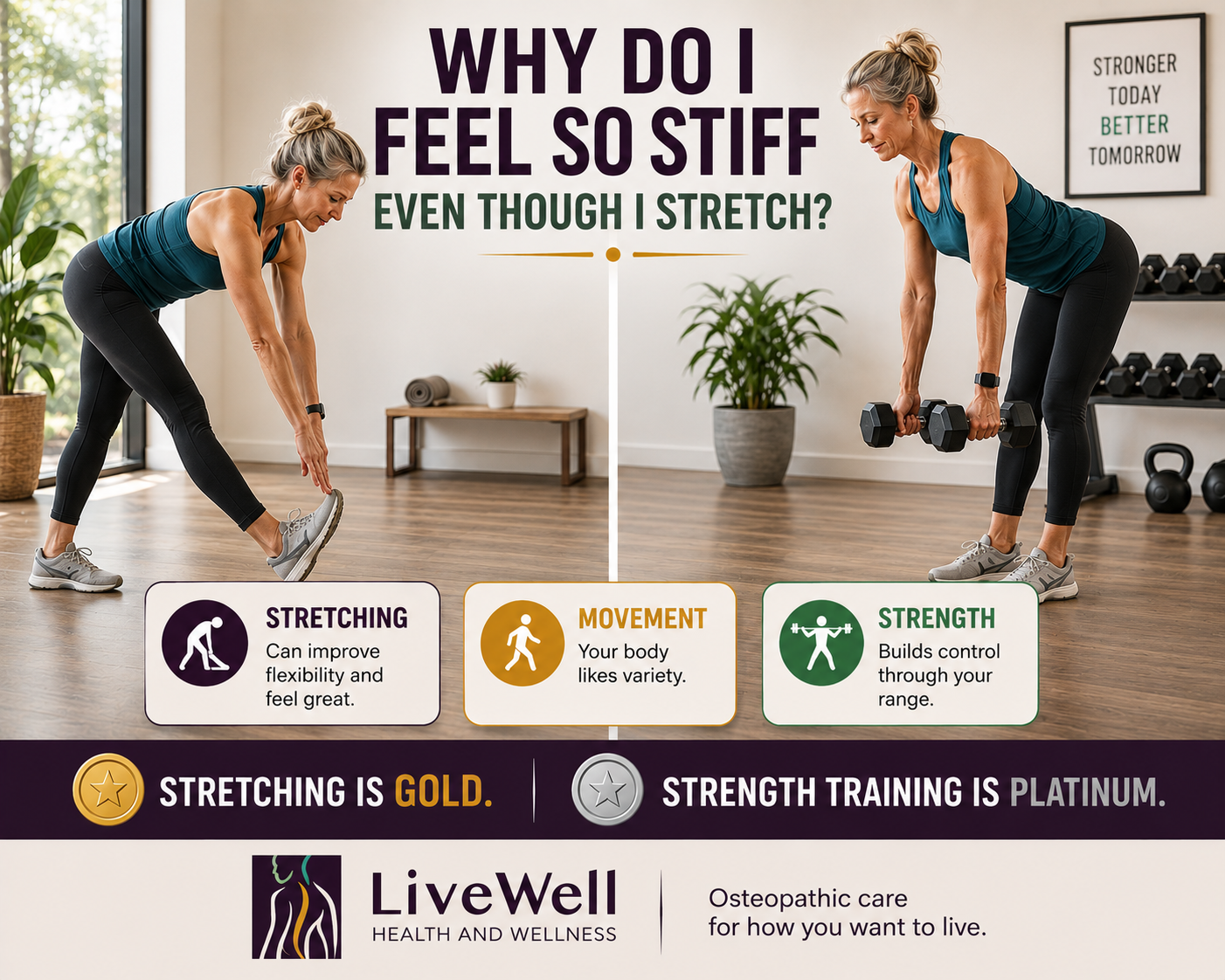
Stretching Is Gold. Strength Training Is Platinum.
This is something I often tell patients:
Stretching is gold, but strength training is platinum.
That's not because stretching is bad. Stretching can improve flexibility, feel wonderful and absolutely deserves a place in many people's routines.
But strength training gives you something stretching alone can't:
The ability to produce and control force through your available range of motion.
And strength training performed through a good range of motion can also improve mobility.
Your body doesn't simply need access to a movement.
It needs to feel capable within that movement.
So if you've spent months repeatedly stretching the same "tight" hamstrings, hips or shoulders without getting the change you're looking for, the answer may not be more stretching.
It may be getting stronger through those ranges.
════════════════════════════════════
Movement Variety Matters Too
Sometimes the simplest explanation for stiffness is that you've been in one position for too long.
Think about getting up after sitting at a desk for three hours.
You stand up and think:
Wow, I'm stiff.
Your body probably hasn't suddenly lost flexibility.
It may simply want to move.
Walking, bending, reaching, rotating and changing positions throughout the day can often be just as important as dedicated stretching.
You don't necessarily need the perfect posture or the perfect stretch.
Sometimes you simply need more movement variety.
════════════════════════════════════
Should You Stop Stretching?
Not at all.
If stretching feels good, helps you move more comfortably or supports an activity you enjoy, keep doing it.
But if you've been stretching the same "tight" area every day for months and it never seems to change, it may be worth asking a different question.
Instead of:
"What do I need to stretch?"
try:
"What does this area need to become better at doing?"
Maybe that's mobility.
Maybe it's strength.
Maybe it's becoming more comfortable in a particular range.
Or maybe you simply need to move more frequently throughout your day.
════════════════════════════════════
How We Can Help
At LiveWell Health and Wellness, we look beyond simply identifying what's "tight."
Osteopathic care combines hands-on osteopathic manual therapy with an individualized movement and exercise plan based on your mobility, strength, symptoms and goals.
The goal isn't to make every part of your body maximally flexible.
It's to help your body have the mobility, strength and confidence it needs for the things you want to do.
════════════════════════════════════
The Bottom Line
Feeling stiff doesn't automatically mean your muscles are too short or that you need to stretch more.
Stretching is useful.
Movement is useful.
And building strength through the ranges you want to use can be incredibly valuable.
Stretching is gold. Strength training is platinum.
Sometimes the answer to feeling less stiff isn't simply stretching farther.
It's helping your body become comfortable, capable and strong enough to move.
════════════════════════════════════
Curious Whether Osteopathic Treatment Could Help Your Specific Problem?
At LiveWell Health and Wellness, every assessment includes hands-on osteopathic manual therapy, education, and an individualized movement and exercise plan designed around your goals.
Book an assessment to learn more.
════════════════════════════════════
Disclaimer
This article is intended for general educational purposes only and should not replace individualized medical advice. New, severe, unexplained or worsening symptoms should be assessed by an appropriate healthcare professional.
Book a visit
Book with Katharine Liberatore
Continue the conversation in clinic. Same-week appointments are usually available.
Book with Katharine