

October 7, 2026 • Katharine Liberatore
What Is Osteopathy — and How Can It Help Me?
Osteopathy is a hands-on approach to musculoskeletal care that helps reduce pain, improve comfortable range of motion, and decrease feelings of stiffness. It focuses on understanding your unique body and goals.
Maybe your back hurts every time you bend.
Your shoulder doesn’t move the way it used to. Your neck feels stiff every morning. Or an old injury has settled down, but something still doesn’t feel quite right when you move.
You don’t necessarily need someone to find something that is “out of alignment” and put it back in place.
You need someone to understand what you’re experiencing, assess how you move, determine what may be relevant, and help you find a way forward.
That’s where osteopathic treatment can help.
So, What Exactly Is Osteopathy?
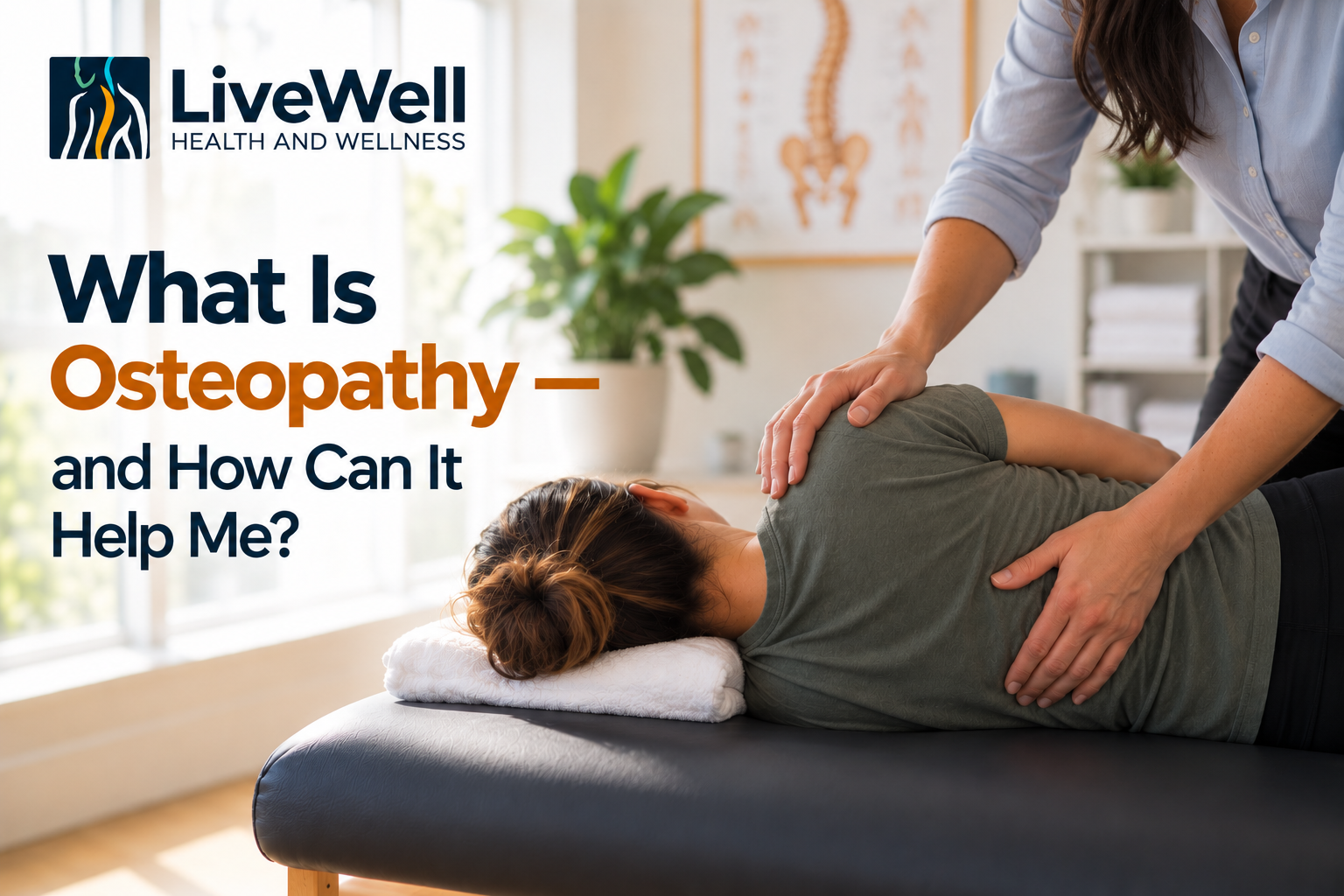
Osteopathy is a hands-on approach to musculoskeletal care.
An osteopathic manual practitioner looks at more than simply the location of your symptoms. We consider your health history, how the problem began, what makes it better or worse, how you move, what you’re having difficulty doing and what you want to get back to.
Then we assess.
That may include looking at joint mobility, muscle and tissue function, range of motion, strength and how your symptoms respond to different movements.
We aren’t searching for a perfectly symmetrical body.
We’re trying to understand what matters for you.
What Does the Hands-On Treatment Actually Do?
This is usually what people really want to know.
Osteopathic manual therapy uses a variety of hands-on techniques directed toward muscles, joints and other tissues.
Depending on the problem, treatment may help reduce pain, improve comfortable range of motion and decrease feelings of stiffness, making everyday movement or activity easier.
Exactly how manual therapy produces these effects is complex. Rather than simply “putting something back in place,” hands-on treatment may influence how the nervous system processes sensation and movement. This may change pain, muscle activity and how comfortable a movement feels.
Sometimes the change is noticeable right on the treatment table.
A movement that felt restricted may feel easier. Turning your head may be more comfortable. Getting up from the table may feel different than it did when you walked in.
That doesn’t mean we’ve magically “fixed” a damaged structure or put something back into place.
It means your symptoms and movement can sometimes change—and that’s useful.
We Test, Treat and Retest
One of the things I consider particularly important in osteopathic treatment is reassessment.
We don’t just treat and hope. We test, treat and retest.
Perhaps bending forward bothers your back.
We can assess that movement before treatment, treat the areas we think may be relevant, and then try the movement again.
Did it become easier?
Did your range of motion change?
Did your symptoms change?
If they did, that’s useful information.
If they didn’t, that’s useful information too.
Treatment should respond to what your body is telling us rather than simply following the same routine at every appointment.
Feeling Better Matters
There’s sometimes a tendency in healthcare to dismiss symptom relief as though it isn’t important.
I don’t agree.
If your neck hurts every time you turn your head, being able to turn it more comfortably matters.
If your back pain is making you afraid to bend, reducing that discomfort can matter.
If stiffness is stopping you from exercising, feeling more comfortable moving can matter.
Feeling better is a worthwhile goal.
But it isn’t the only goal.
Feeling Better Is Valuable. Staying Better Matters Too.
This is where our approach at LiveWell goes beyond the treatment table.
If hands-on treatment helps you feel or move better, we want to build on that.
Depending on your situation, that might mean improving strength, gradually increasing your tolerance for a particular activity, working on mobility or simply helping you return to movements you’ve been avoiding.
Exercise doesn’t need to be complicated, and it certainly doesn’t need to take over your life.
It needs to be appropriate for you, your body and your goals.
Manual therapy can help with symptoms and movement. Exercise can help build the capacity to do more.
Those approaches don’t have to compete with each other.
They can work together.
We Also Want You to Understand What’s Happening
This has become an increasingly important part of how I practise as an osteopathic manual practitioner.
Modern pain science has taught us that pain is more complex than simply measuring the condition of a muscle, joint or other tissue.
So if something hurts, I don’t want you leaving my office thinking your body is fragile, damaged or dependent on someone repeatedly “putting it back into place.”
I want you to understand what we found, what we think may be contributing to your symptoms, what we’re trying to accomplish with treatment and what you can do yourself.
Because recovery works best as a team effort.
Treatment shouldn’t just happen to you. You should be part of it.
Is Osteopathy About Treating the Whole Body?
You’ll often hear that osteopathy “treats the whole body.”
I think that phrase needs some context.
It doesn’t mean that every painful shoulder requires treatment of the pelvis, or that every back problem is caused by something happening somewhere else.
It means we don’t automatically assume that the painful spot tells us the entire story.
If your hip hurts, for example, we may look at how the hip moves, what activities provoke it, your strength and mobility, and other areas that are clinically relevant to the problem.
Sometimes the painful area deserves most of our attention.
Sometimes looking a little more broadly gives us useful information.
The assessment should determine that—not an osteopathic theory applied to everyone.
What Does Osteopathic Care at LiveWell Look Like?
There isn’t one treatment protocol that every person receives.
Your appointment is built around your symptoms, your assessment and what you want to be able to do.
That means combining:
- hands-on osteopathic manual therapy
- movement and functional assessment
- education about what may be happening
- individualized exercise when appropriate
- reassessment to see how you respond
And if something doesn’t appear appropriate for osteopathic manual treatment—or your symptoms suggest that further medical assessment is warranted—we’ll tell you.
Good care isn’t about trying to treat everything.
It’s about recognizing where we can be useful.
The Bottom Line
Osteopathy is hands-on care.
But good osteopathic care shouldn’t end when the hands come off.
At LiveWell Health and Wellness, our osteopathic manual practitioner combines hands-on osteopathic manual therapy with assessment, education and individualized movement and exercise.
Our goal is to help you feel and move better while also giving you the understanding, confidence and tools to keep moving forward.
Sometimes that starts with reducing pain or stiffness.
Sometimes it’s getting a movement back.
Sometimes it’s helping you return to the gym, your sport, your work or simply the everyday things you’ve stopped doing comfortably.
Good treatment isn’t just about what happens on the treatment table. It’s about helping you get back to your life.
How We Can Help
Curious whether osteopathic manual treatment could help your specific problem?
At LiveWell Health and Wellness, every osteopathic assessment includes hands-on osteopathic manual therapy, education, and an individualized movement and exercise plan designed around your needs and goals.
Book an assessment to learn more.
Disclaimer
This article is intended for general educational purposes and does not replace individualized medical advice. New, severe, unexplained or worsening symptoms should be assessed by an appropriate healthcare professional.
Book a visit
Book with Katharine Liberatore
Continue the conversation in clinic. Same-week appointments are usually available.
Book with Katharine