

July 13, 2026 • Katharine Liberatore
Is It Safe to Exercise With Back Pain?
If you have back pain, you might wonder if exercise is safe or if you should rest. For most people, appropriate movement is key to recovery. Learn how to exercise safely with back pain.
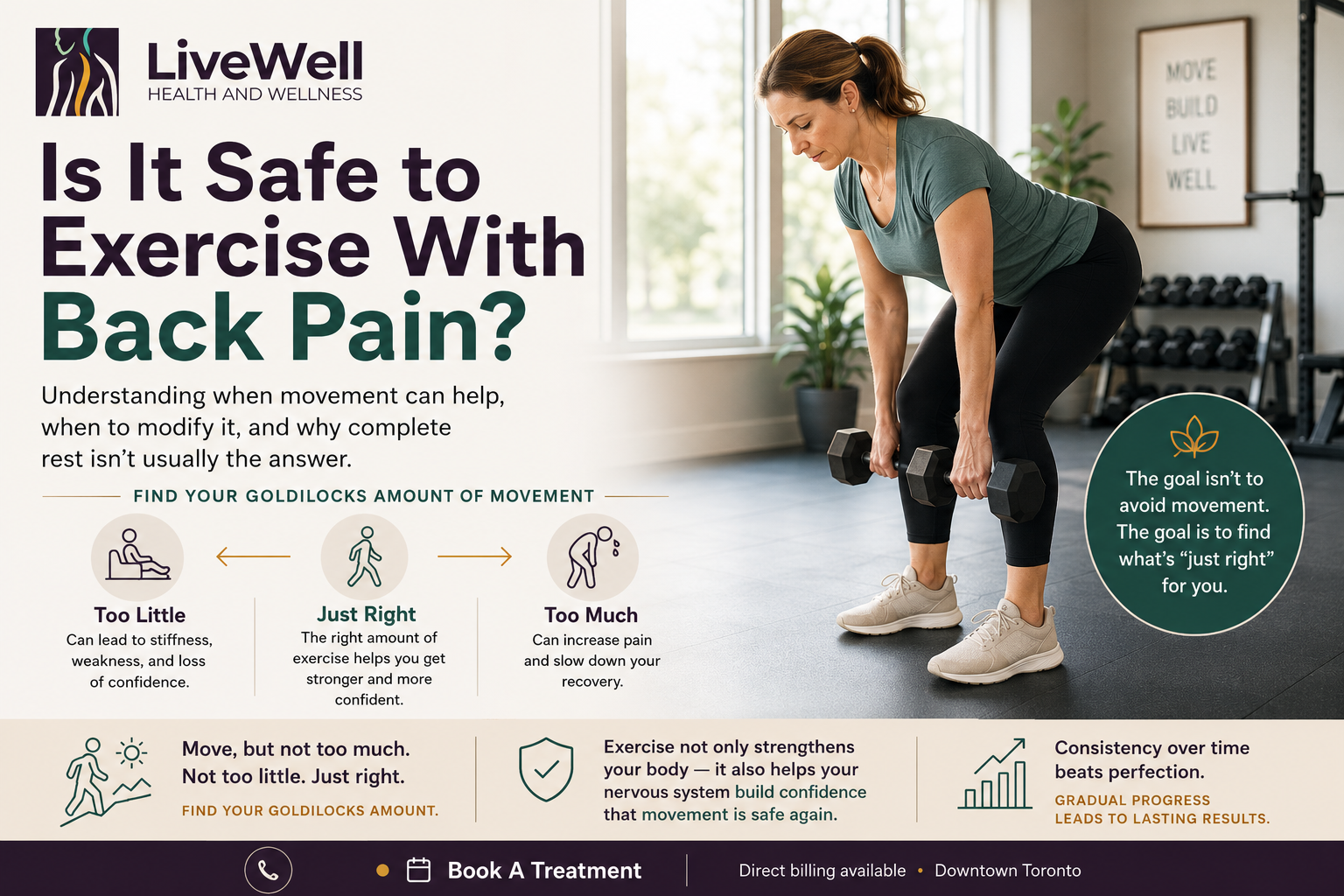
Understanding when movement can help, when to modify it, and why complete rest isn't usually the answer.
If you've ever had back pain, you've probably wondered whether you should stop exercising.
Maybe you've even heard conflicting advice.
One person tells you to rest.
Another tells you to push through the pain.
Someone else says you should avoid bending, twisting, lifting, or pretty much everything else.
It's no wonder people become confused.
At our osteopathy clinic in downtown Toronto, this is one of the most common questions we hear.
The answer isn't always simple, but for most people, appropriate movement is an important part of recovery.
════════════════════════════════════
Should I Rest My Back?
Years ago, prolonged bed rest was commonly recommended for back pain.
Today, we know that complete rest is rarely the best approach for most people.
That's because our bodies are designed to move.
When we stop moving completely, muscles become weaker. Joints become stiffer. Confidence decreases. Everyday activities often become more difficult.
That doesn't mean you should ignore severe pain or force yourself through activities that significantly increase your symptoms.
Instead, the goal is usually to find a level of movement your body can tolerate and gradually build from there.
════════════════════════════════════
Hurt Doesn't Always Mean Harm
This is one of the hardest concepts for people to accept.
Many of us naturally assume:
"If it hurts, I must be damaging something."
Sometimes that's true.
If you sprain your ankle or break a bone, pain is an important warning sign.
But with many episodes of back pain—particularly persistent or recurring back pain—the relationship isn't always that straightforward.
Pain is your body's way of protecting you.
Sometimes it's responding to tissue damage.
Other times it's responding to increased sensitivity within the nervous system.
That means a movement can feel uncomfortable without necessarily causing further injury.
The goal isn't to ignore pain.
The goal is to understand what your body may be trying to tell you.
════════════════════════════════════
How Much Pain Is Okay?
This is probably the question patients ask me most often.
Unfortunately, there isn't one number that applies to everyone.
As a general guide, mild discomfort during exercise isn't necessarily a problem if:
• The pain settles shortly after you finish.
• Your symptoms aren't significantly worse the following day.
• You're gradually improving over time.
On the other hand, if your pain becomes progressively worse, causes significant limping, or continues to increase for several days afterward, it's probably a sign that the activity needs to be modified.
════════════════════════════════════
The Goldilocks Principle
One analogy I often use with patients is the story of Goldilocks.
If you remember the story, one bowl of porridge was too hot.
One was too cold.
One was just right.
Exercise often works the same way.
Doing too little may lead to stiffness, reduced strength, and loss of confidence in movement.
Doing too much—especially too soon—may temporarily increase pain or slow your recovery.
The goal isn't to avoid movement.
Nor is it to push through significant pain.
The goal is to find the amount of movement that's "just right" for where your body is today.
The encouraging part is that the "just right" amount usually changes as you recover.
Today, it might be a 10-minute walk.
A few weeks from now, it might be a one-hour hike, a workout at the gym, or a game of pickleball.
Recovery isn't about finding the perfect exercise.
It's about finding the right dose of exercise and gradually increasing it as your body becomes stronger and more confident.
One of the goals of exercise isn't simply to strengthen muscles—it's also to help your nervous system gradually become more confident that normal movement is safe again.
════════════════════════════════════
Should I Avoid Certain Movements?
Many people become afraid of bending, twisting, lifting, or reaching after experiencing back pain.
Sometimes that's understandable, especially if those movements were painful during a flare-up.
But avoiding movement forever usually isn't the answer.
Our backs are designed to bend.
They're designed to twist.
They're designed to lift.
The goal is to gradually rebuild confidence in those movements rather than believing they're inherently dangerous.
In many cases, avoiding movement for too long can actually increase fear and reduce confidence, making everyday activities feel more difficult than they need to.
════════════════════════════════════
What If Exercise Makes My Pain Worse?
This is where context matters.
Although we're talking about back pain, the same principle applies to many painful conditions.
When we begin exercising after an injury—or after being inactive for a while—it's normal for the body to need time to adapt.
That doesn't necessarily mean you've caused damage.
Think about returning to the gym after several months away.
Your muscles might feel sore the next day.
That soreness doesn't mean you've injured yourself.
It often means your body is adapting to a new demand.
Back pain can sometimes work in a similar way.
A temporary increase in symptoms doesn't automatically mean you've harmed yourself.
The important question isn't simply:
"Did it hurt?"
It's also:
"How did my body respond over the next 24 to 48 hours?"
That question often tells us much more than what happened during the exercise itself.
════════════════════════════════════
What Types of Exercise Are Best?
There isn't one perfect exercise for everyone.
The best exercise is often the one you can do consistently without significantly aggravating your symptoms.
Depending on the individual, this may include:
• Walking
• Strength training
• Swimming
• Cycling
• Yoga
• Pilates
• Mobility exercises
The most important thing is choosing activities that you enjoy and can gradually progress over time.
Consistency almost always beats perfection.
════════════════════════════════════
When Should I Seek Professional Advice?
If you're unsure whether a particular activity is appropriate, or if your pain continues to worsen despite modifying your exercise, it's worth seeking an assessment.
The goal isn't to stop you from moving.
It's to help you move with greater confidence.
A healthcare professional can often identify movements that may be contributing to your symptoms and help you develop a plan that's appropriate for your individual situation.
════════════════════════════════════
How We Can Help
At LiveWell Health and Wellness, we believe movement is one of the most powerful tools for recovery.
Our goal isn't simply to reduce pain in the short term.
It's to help you understand your symptoms, build confidence in your body, and gradually return to the activities that matter most to you.
Treatment may include osteopathic manual therapy, education, movement recommendations, and strategies designed to improve mobility, strength, and overall function.
════════════════════════════════════
Still Unsure Whether You Should Be Exercising?
If you're avoiding movement because you're worried about making your back worse, you're not alone.
A thorough assessment can often help determine which activities are appropriate, which movements may need to be modified temporarily, and how to safely build back toward the activities you enjoy.
The goal isn't to avoid exercise forever.
The goal is to move with confidence again.
════════════════════════════════════
The Bottom Line
For most people, movement is an important part of recovering from back pain.
That doesn't mean every exercise is appropriate for every person, or that you should ignore significant pain.
But it does mean that complete rest is rarely the best long-term solution.
Finding the right balance—the Goldilocks amount of movement that's not too much and not too little—is often one of the most important parts of recovery.
As your body becomes stronger, more confident, and more resilient, that "just right" amount of movement usually grows too.
Understanding pain is often the first step toward recovering from it. The more you understand how pain works, the less confusing—and often less frightening—it becomes.
════════════════════════════════════
Disclaimer
This article is intended for general educational purposes only and should not replace individualized medical advice.
While most episodes of back pain are not caused by a serious medical condition, seek prompt medical attention if you experience significant trauma, fever, unexplained weight loss, loss of bowel or bladder control, numbness around the groin ("saddle" numbness), or progressive weakness or numbness in your legs.
Book a visit
Book with Katharine Liberatore
Continue the conversation in clinic. Same-week appointments are usually available.
Book with Katharine